Introduction
The human body depends on a constant supply of healthy red blood cells to transport oxygen and sustain life. Erythropoiesis represents the carefully controlled biological process that produces these cells in adequate numbers to meet physiological demands. Because oxygen delivery supports metabolism, tissue repair, and organ function, uninterrupted red cell formation remains essential for survival.To maintain balance, the body continuously monitors oxygen levels, nutritional status, and bone marrow activity. Any disruption in this system quickly reflects in blood parameters and clinical symptoms. Therefore, understanding this process plays a crucial role in laboratory medicine and clinical diagnosis.
Overview of Red Blood Cell Formation
Red blood cells originate from specialized stem cells located in the bone marrow. Through a series of orderly developmental steps, these immature cells gradually acquire hemoglobin, lose their nucleus, and enter circulation as mature erythrocytes. Meanwhile, regulatory hormones and nutrients ensure proper timing, quantity, and quality of cell production.An average adult generates nearly two million red blood cells every second. This remarkable turnover compensates for natural cell destruction and preserves normal blood composition.
Definition and Core Function
Red blood cell production begins with hematopoietic stem cells and ends with mature erythrocytes circulating in peripheral blood. These cells perform two primary tasks:
Because hemoglobin binds oxygen efficiently, red cells act as mobile oxygen carriers and sustain cellular respiration.
Sites of Red Blood Cell Production Across Life Stages
The anatomical location of red cell production shifts as human development progresses.
Embryonic Period
During early embryonic life, the yolk sac initiates blood formation. This site supports the embryo until organ development advances.
Fetal Period
As gestation continues, the liver becomes the primary site of red cell production. The spleen also contributes during mid-gestation, while bone marrow gradually gains activity toward the end of fetal life.
After Birth
Following birth, red bone marrow assumes full responsibility for red blood cell production. In adults, active marrow remains concentrated in:
Yellow marrow replaces inactive regions over time, reducing production capacity with age.
Cellular Origin and Developmental Pathway
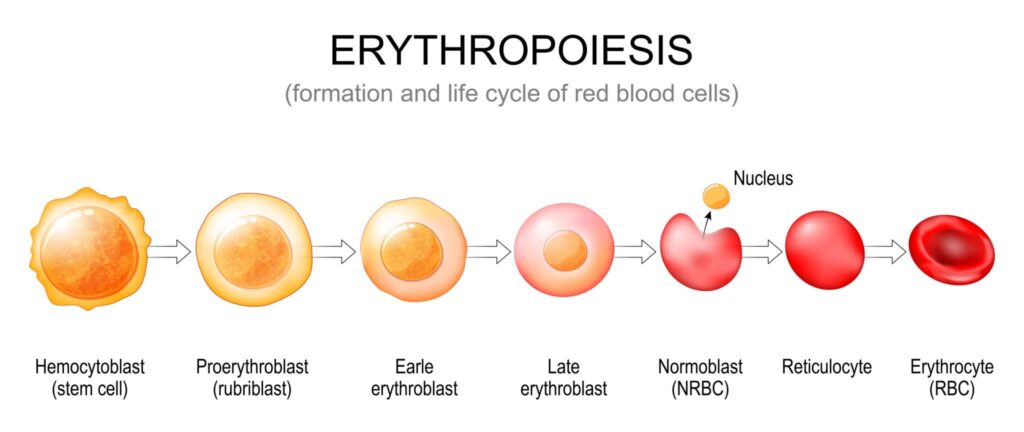
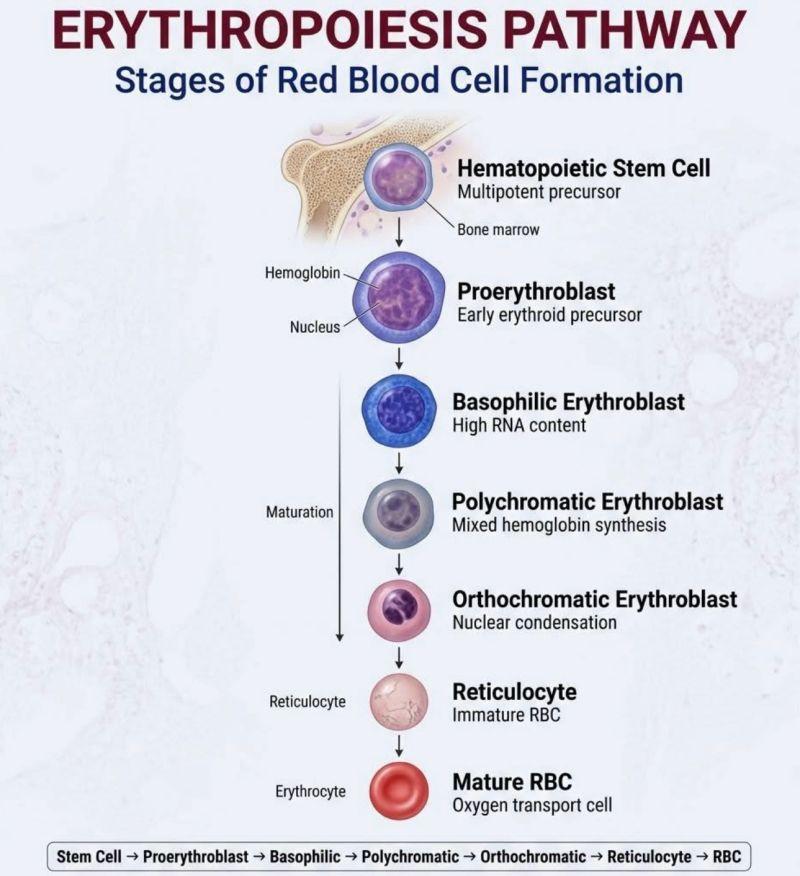
All blood cells originate from a common precursor known as the pluripotent hematopoietic stem cell. From this source, differentiation proceeds along the myeloid lineage to generate red blood cell precursors.
The developmental sequence follows this progression:
Hematopoietic stem cell
Common myeloid progenitor
Proerythroblast
Basophilic erythroblast
Polychromatic erythroblast
Orthochromatic erythroblast
Reticulocyte
Mature erythrocyte
Each stage reflects structural and functional refinement.
Morphological Changes During Maturation
As red cell precursors mature, several predictable changes occur:
Cell size decreases steadily
Nuclear chromatin condenses
Cytoplasm shifts from blue to pink
Hemoglobin concentration increases
The nucleus disappears completely
These transformations ensure optimal oxygen-carrying efficiency.
Description of Individual Developmental Stages
Proerythroblast
This large cell measures approximately 15–20 micrometers. A prominent nucleus with visible nucleoli dominates the cell, while deeply basophilic cytoplasm reflects high RNA content. At this stage, active protein synthesis prepares the cell for hemoglobin production.
Basophilic Erythroblast
Cell size reduces slightly as nucleoli vanish. Dense blue cytoplasm persists due to abundant ribosomes. Hemoglobin synthesis begins here, marking functional commitment.
Polychromatic Erythroblast
Further maturation leads to a grayish cytoplasmic color caused by mixed RNA and hemoglobin content. Nuclear chromatin becomes more compact, indicating reduced transcriptional activity.
Orthochromatic Erythroblast
The cell now appears smaller with pink cytoplasm. The nucleus becomes pyknotic and eventually extrudes from the cell, allowing final maturation.
Reticulocyte
This enucleated cell retains residual RNA, which produces a faint bluish hue. Reticulocytes enter circulation and mature within one to two days. A normal reticulocyte count ranges between 0.5% and 2%.
Mature Erythrocyte
Fully developed red blood cells display a biconcave disc shape, pink cytoplasm, and a diameter of 7–8 micrometers. These cells circulate for approximately 120 days.
Hormonal Regulation of Red Cell Production
Erythropoiesis responds primarily to erythropoietin, a glycoprotein hormone synthesized mainly by the kidneys. The liver contributes a smaller portion of production.
Low oxygen levels stimulate erythropoietin release. Conditions that trigger this response include anemia, blood loss, chronic lung disease, heart failure, and high-altitude exposure. Once released, erythropoietin accelerates bone marrow activity and enhances red cell output.
Nutritional and Physiological Requirements
Efficient red blood cell production requires multiple essential factors:
Iron
Iron forms the core of the hemoglobin molecule. Deficiency limits hemoglobin synthesis and leads to microcytic anemia.
Vitamin B12
This vitamin supports DNA synthesis. Deficiency causes impaired nuclear maturation and results in megaloblastic anemia.
Folic Acid
Folate facilitates cell division. Insufficient intake disrupts red cell development and produces macrocytic anemia.
Protein
Globin chain synthesis depends on adequate protein availability.
Vitamin B6
This vitamin supports heme synthesis and enzymatic activity.
Hormonal Influence
Thyroxine, testosterone, and growth hormone stimulate bone marrow function and increase red cell production.
Duration of Red Cell Formation
From stem cell commitment to mature erythrocyte release, the complete developmental process requires approximately five to seven days. This rapid turnover enables quick adaptation to physiological stress.
Destruction and Recycling of Red Blood Cells
After completing their lifespan, aging red blood cells undergo removal by macrophages in the spleen, liver, and bone marrow. Hemoglobin breakdown yields:
Iron, which reenters storage pools
Bilirubin, which exits the body through bile
This recycling process conserves resources and maintains metabolic efficiency.
Abnormalities in Red Cell Production
Disruptions in erythropoiesis result in various hematological disorders.
Ineffective Red Cell Production
In this condition, bone marrow generates precursor cells that fail to mature properly. Thalassemia and megaloblastic anemia commonly exhibit this pattern.
Increased Red Cell Production
Chronic hypoxia, high altitude exposure, and polycythemia stimulate excessive red cell formation.
Decreased Red Cell Production
Bone marrow failure, chronic kidney disease, chemotherapy, and aplastic anemia reduce red cell output.
Clinical Importance in Medical Practice
Understanding erythropoiesis assists clinicians in diagnosing anemia, assessing bone marrow function, and monitoring treatment response. Physicians also rely on this knowledge when managing kidney disease and evaluating unexplained fatigue.
Role of Reticulocyte Count
Reticulocyte percentage reflects real-time bone marrow activity and indirectly evaluates erythropoiesis.
Thus, reticulocyte analysis remains a valuable diagnostic tool.
Adaptation at High Altitude
Reduced oxygen pressure at high altitude triggers increased erythropoietin secretion. Consequently, red cell mass and hemoglobin concentration rise, enhancing oxygen delivery. This physiological adaptation improves endurance and survival in hypoxic environments.
Conclusion
Erythropoiesis represents a complex, finely regulated process that ensures continuous red blood cell production throughout life. Originating from hematopoietic stem cells, the process advances through well-defined stages until mature erythrocytes enter circulation. Hormonal regulation, nutritional support, and healthy bone marrow function remain essential for normal red cell output. Disruption at any level leads to anemia or excessive cell production, highlighting the clinical significance of this process for healthcare professionals and laboratory scientists.
Disclaimer
This article is intended for educational purposes only. It does not replace professional medical advice, diagnosis, or treatment. Always consult qualified healthcare professionals for clinical decisions.
Frequently Asked Questions
Written by Jambir Sk Certified Medical Laboratory Technologist
Disclaimer: This content is for educational purposes only and should not be consideredas medical advice. Always consult a qualified doctor.We do not provide professional medical advice, diagnosis, or treatment.All health-related content is based on research, knowledge, and general awareness.Always consult a licensed healthcare provider for any medical concerns.HealthSeba.com will not be responsible for any loss, harm, or damage caused by the use of information available on this site.