Introduction
Chronic Myeloid Leukemia (CML) is a chronic blood cancer that mainly affects the bone marrow and white blood cells. It is also known as chronic myelogenous leukemia. CML is different from acute leukemias because it generally progresses more slowly, particularly during its chronic phase.
Overview
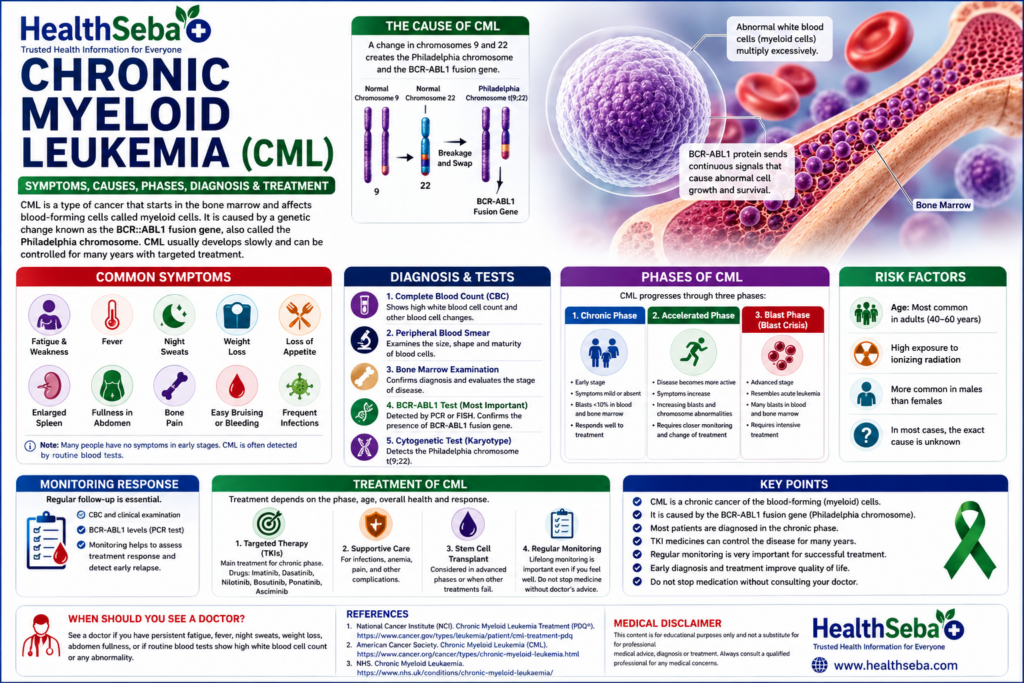
Chronic Myeloid Leukemia (CML) develops from abnormal blood-forming cells in the bone marrow. These abnormal cells produce excessive numbers of myeloid cells, particularly abnormal white blood cells.A major characteristic of CML is the presence of the BCR::ABL1 fusion gene. This abnormal gene produces a protein called BCR::ABL1 tyrosine kinase, which continuously sends signals that encourage leukemia cells to grow and survive.The abnormal chromosome associated with this process is commonly called the Philadelphia chromosome. It results from an exchange of genetic material between chromosomes 9 and 22. CML mainly occurs in adults and is uncommon in children.
CML Develop
Normal bone marrow produces different types of blood cells, including:
In CML, a genetic change occurs in a blood-forming cell. This creates the BCR::ABL1 fusion gene, which promotes uncontrolled growth of abnormal myeloid cells.These cells can accumulate in the bone marrow and blood. As the disease progresses, they may interfere with the production and function of normal blood cells.This genetic change is generally acquired during a person’s lifetime rather than inherited from a parent.
Causes
The exact reason why a particular person develops the genetic change that causes CML is usually not known.However, the most clearly established environmental risk factor is exposure to high levels of ionizing radiation. Such exposure is uncommon in the general population.Importantly, CML is not usually caused by diet, everyday stress, ordinary infections or normal lifestyle activities.Most people diagnosed with CML do not have an identifiable cause.
Risk Factors
Several factors may be associated with an increased risk of developing CML.
1. Age
CML is primarily an adult disease and becomes more common with increasing age.
2. Radiation Exposure
High-dose exposure to ionizing radiation is a recognized risk factor.
3. Sex
CML occurs in both men and women, although it is somewhat more common in men.
Having a risk factor does not mean that a person will definitely develop CML.
Symptoms
Many people with Chronic Myeloid Leukemia have no symptoms when the disease is first diagnosed. CML is often discovered accidentally when a routine blood test shows an abnormal white blood-cell count.
When symptoms occur, they may include:
- Fatigue
- Weakness
- Fever
- Night sweats
- Unexplained weight loss
- Loss of appetite
- Feeling full after eating a small amount
- Abdominal discomfort
- Enlarged spleen
- Bone pain
- Recurrent infections
- Easy bruising or bleeding
These symptoms are not specific to CML and can occur in many other conditions.
Fatigue and Weakness
CML may affect the normal production of red blood cells, resulting in anemia.
Anemia can cause:
- Tiredness
- Weakness
- Shortness of breath
- Reduced exercise tolerance
- Pale appearance
Enlarged Spleen
An enlarged spleen is a common physical finding in CML.
The spleen is located in the upper-left part of the abdomen. When it becomes enlarged, a person may experience:
- Fullness in the left upper abdomen
- Abdominal discomfort
- Feeling full quickly after eating
- Reduced appetite
Diagnosis
A diagnosis of CML cannot be made from symptoms alone. Doctors use blood tests, genetic tests and sometimes bone marrow examination to confirm the diagnosis.
1. Complete Blood Count (CBC)
A CBC with differential is often the first important investigation.
The test measures:
- Hemoglobin
- Red blood cells
- White blood cells
- Platelets
- Different types of white blood cells
CML commonly produces a markedly increased white blood-cell count, although the exact blood findings vary between patients.
CBC May Show
- Increased total WBC count
- Increased neutrophils and other myeloid cells
- Changes in platelet count
- Possible anemia
- Presence of immature myeloid cells
A CBC abnormality does not by itself confirm CML.
2. Peripheral Blood Smear
A peripheral blood smear allows blood cells to be examined under a microscope.
The laboratory can assess the appearance and maturity of different white blood cells and identify abnormal patterns that may suggest a myeloproliferative disorder such as CML.
3. Bone Marrow Examination
A bone marrow aspiration and/or biopsy may be performed to evaluate blood-cell production and obtain material for further testing.
The sample can help doctors assess:
- Cellularity of the marrow
- Myeloid cell proliferation
- Blast percentage
- Chromosomal abnormalities
- Genetic changes
Not every patient necessarily requires the same combination of tests; the hematologist determines the appropriate diagnostic work-up.
Phases of Chronic Myeloid Leukemia
Unlike many solid cancers, CML is not usually described using conventional Stage 1, Stage 2, Stage 3 or Stage 4 staging.
Instead, doctors classify CML into phases.
The commonly described phases are:
- Chronic phase
- Accelerated phase
- Blast phase
1. Chronic Phase CML
Most people are diagnosed during the chronic phase.
During this phase:
- The disease usually progresses relatively slowly.
- Symptoms may be absent or mild.
- The number of blasts is relatively low.
- CML usually responds well to standard targeted treatment.
Many patients can live for many years with appropriate treatment and regular monitoring.
2. Accelerated Phase CML
In accelerated-phase disease, leukemia cells begin to behave more aggressively.
There may be:
- Increasing blast cells
- Increasing symptoms
- Changes in chromosome abnormalities
- Problems with blood-cell counts
- Reduced response to treatment
Definitions of accelerated phase can vary between classification systems. Some modern classifications have changed how this phase is defined, so the patient’s hematologist should explain the classification being used.
3. Blast Phase CML
Blast phase, also called blast crisis, is the most advanced form of CML.
In this phase, the disease behaves more like an acute leukemia, with a large increase in immature blast cells.
Symptoms may become more severe, including:
- Fever
- Weight loss
- Severe fatigue
- Bleeding
- Infections
- Bone pain
- Enlarged spleen
Treatment generally requires more intensive therapy and may include a TKI combined with other treatments and, in eligible patients, stem-cell transplantation.
CML vs AML vs CLL vs ALL
| Feature | CML | AML | CLL | ALL |
|---|
| Full name | Chronic Myeloid Leukemia | Acute Myeloid Leukemia | Chronic Lymphocytic Leukemia | Acute Lymphocytic Leukemia |
| Main lineage | Myeloid | Myeloid | Lymphoid | Lymphoid |
| Typical course | Usually chronic/slow initially | Acute/rapid | Usually chronic | Acute/rapid |
| Important feature | BCR::ABL1 | Various genetic changes | Usually abnormal B lymphocytes | Lymphoblasts |
| Classification | Phases | Subtypes/risk groups | Rai/Binet systems commonly used | Subtypes/risk features |
| Main diagnostic tests | CBC, smear, BCR::ABL1, cytogenetics | CBC, marrow, flow/genetics | CBC, flow cytometry | CBC, marrow, flow/genetics |
CML Be Prevented
There is currently no reliable way to prevent most cases of CML because the genetic change responsible for the disease usually occurs unexpectedly. Avoiding unnecessary exposure to high levels of ionizing radiation is generally advisable, but most people with CML have no identifiable preventable cause. There is also no widely recommended screening test specifically for CML. However, routine blood tests may sometimes detect CML before symptoms develop.
Conclusion
Chronic Myeloid Leukemia (CML) is a blood and bone-marrow cancer characterized by abnormal growth of myeloid cells and the presence of the BCR::ABL1 fusion gene in most cases. The associated Philadelphia chromosome played a major role in understanding the disease and developing targeted treatments.CML usually begins in the chronic phase, during which many patients have few or no symptoms. It may progress to accelerated or blast phase, although modern targeted therapies have significantly changed the management of CML.Diagnosis involves CBC, peripheral blood smear, bone marrow evaluation when indicated, cytogenetic testing and molecular testing for BCR::ABL1. The main treatment for chronic-phase CML is usually a tyrosine kinase inhibitor (TKI), with regular molecular monitoring to assess treatment response.
Disclaimer
This article is provided for educational and general health-information purposes only. It should not be considered a substitute for professional medical advice, diagnosis or treatment. Laboratory results must be interpreted in the appropriate clinical context. Consult a qualified healthcare professional for individual medical concerns.
Frequently Asked Questions
Written by Jambir Sk Certified Medical Laboratory Technologist
Disclaimer: This content is for educational purposes only and should not be consideredas medical advice. Always consult a qualified doctor.We do not provide professional medical advice, diagnosis, or treatment.All health-related content is based on research, knowledge, and general awareness.Always consult a licensed healthcare provider for any medical concerns.HealthSeba.com will not be responsible for any loss, harm, or damage caused by the use of information available on this site.
References & Sources