Introduction
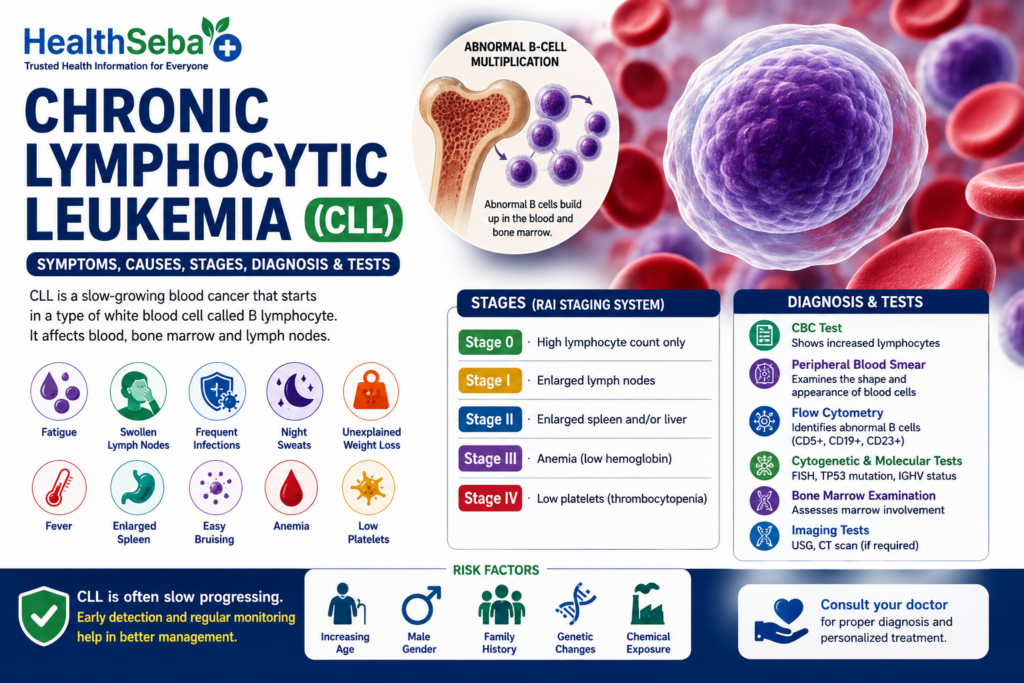
Chronic Lymphocytic Leukemia (CLL) is a slow-growing type of blood cancer that mainly affects abnormal B lymphocytes. These cells can accumulate in the blood, bone marrow and lymphoid tissues. CLL may cause swollen lymph nodes, fatigue, recurrent infections and other symptoms, although some people have no symptoms when it is first diagnosed.
Chronic Lymphocytic Leukemia
Chronic Lymphocytic Leukemia (CLL) is a cancer of the blood-forming tissues in which abnormal lymphocytes accumulate in the blood and bone marrow.
The word “chronic” indicates that CLL generally progresses more slowly than acute leukemias. “Lymphocytic” refers to the involvement of lymphocytes, and “leukemia” indicates a cancer affecting blood-forming tissues.
CLL is closely related to Small Lymphocytic Lymphoma (SLL). Both involve a similar type of abnormal B lymphocyte, but CLL predominantly involves the blood and bone marrow, whereas SLL mainly involves lymph nodes and other lymphoid tissues.
Overview
CLL develops when genetic changes affect the normal growth, survival or regulation of lymphocytes. The abnormal cells can accumulate over time and may interfere with normal blood-cell production.
As the disease progresses, the bone marrow may have difficulty producing adequate numbers of healthy:
- Red blood cells
- Normal white blood cells
- Platelets
This can contribute to anemia, increased susceptibility to infections, bruising or bleeding. CLL cells may also accumulate in lymph nodes, spleen and liver, causing enlargement of these organs.
Importantly, CLL does not always cause symptoms at diagnosis. In some people, an abnormal lymphocyte count found during a routine blood test is the first indication that further investigation is needed.
Symptoms of CLL
Early CLL may cause no noticeable symptoms. When symptoms develop, they may vary depending on the extent of the disease and its effects on normal blood cells and immune function.
Common Symptoms
- Persistent tiredness or weakness
- Swollen, usually painless lymph nodes
- Recurrent or frequent infections
- Fever without an obvious cause
- Drenching night sweats
- Unexplained weight loss
- Reduced appetite
- Fullness or discomfort in the upper abdomen
- Enlarged spleen or liver
Symptoms Related to Low Blood Counts
If CLL interferes with normal blood-cell production:
Anemia may cause:
- Fatigue
- Weakness
- Shortness of breath
- Pale appearance
Low platelet levels may cause:
- Easy bruising
- Nosebleeds
- Bleeding gums
- Small red or purple spots on the skin
Symptoms such as fatigue, fever or swollen lymph nodes can occur in many conditions and do not by themselves mean that a person has CLL. Persistent or unexplained symptoms should be evaluated by a healthcare professional.
Causes
The exact cause of CLL is not completely understood. Cancer develops when changes in the DNA of cells alter normal mechanisms controlling cell growth and survival. In CLL, acquired genetic changes can contribute to the abnormal survival and accumulation of B lymphocytes. In most cases, there is no single identifiable cause. Having a risk factor does not mean that a person will definitely develop CLL, and some people develop CLL without any known risk factors.
Risk Factors for CLL
Several factors are associated with an increased likelihood of developing CLL.
1. Age
CLL occurs mainly in older adults and is uncommon in children. Increasing age is one of the strongest recognized risk factors.
2. Family History
A family history of CLL or certain related lymphoid disorders can increase the risk.
3. Sex
CLL occurs more frequently in males than females.
4. Monoclonal B-Cell Lymphocytosis
Monoclonal B-cell lymphocytosis (MBL) is a condition in which a small population of abnormal B cells can be detected. Some people with MBL may eventually develop CLL, although many do not.
5. Certain Environmental Exposures
Research has investigated possible associations between CLL and certain occupational or chemical exposures. However, not every reported association has been firmly established as a direct cause.
Important: A risk factor is not the same as a cause. Many people diagnosed with CLL have no obvious risk factors
Types and Stages of CLL
CLL is not usually divided into simple “types” in the way some other diseases are. Instead, doctors consider the disease’s clinical stage, biological characteristics and genetic features.
CLL is closely related to Small Lymphocytic Lymphoma (SLL).
CLL vs SLL
CLL: Abnormal B lymphocytes are mainly present in the blood and bone marrow.
SLL: Abnormal B lymphocytes mainly involve lymph nodes and lymphoid tissues.
Doctors commonly use the Rai staging system or Binet classification to describe the extent of CLL.
Rai Staging System for CLL
The Rai system divides CLL into five stages: Stage 0, I, II, III and IV.
Rai Stage 0
- Increased lymphocyte count
- No significant lymph-node enlargement
- No enlarged liver or spleen
- No anemia
- No thrombocytopenia
This is generally considered a low-risk stage.
Rai Stage I
- Increased lymphocyte count
- Enlarged lymph nodes
- No anemia or thrombocytopenia
Generally considered an intermediate-risk stage.
Rai Stage II
- Increased lymphocyte count
- Enlarged spleen and/or liver
- Lymph-node enlargement may also occur
Generally considered an intermediate-risk stage.
Rai Stage III
- Increased lymphocyte count
- Anemia
- Lymph nodes, spleen or liver may or may not be enlarged
Generally considered a high-risk stage.
Rai Stage IV
- Increased lymphocyte count
- Thrombocytopenia
- Lymph nodes, spleen or liver may or may not be enlarged
Generally considered a high-risk stage
Binet Classification of CLL
The Binet system uses three clinical stages: A, B and C.
Binet Stage A
- Fewer than three areas of lymphoid enlargement
- No significant anemia
- No thrombocytopenia
Binet Stage B
- Three or more areas of lymphoid involvement
- No significant anemia or thrombocytopenia
Binet Stage C
- Anemia and/or thrombocytopenia
- The number of involved lymphoid areas does not determine this stage
The Binet classification is another method used to assess disease extent and prognosis.
Diagnosis of CLL
CLL diagnosis usually involves a combination of medical history, physical examination and laboratory investigations.
There is no single test that should be interpreted in isolation. Doctors may use several investigations to establish the diagnosis and understand the characteristics of the abnormal lymphocytes.
Tests for CLL
1. Complete Blood Count (CBC)
A CBC with differential is often an important first investigation.
It provides information about:
- Total white blood cell count
- Absolute lymphocyte count
- Hemoglobin
- Platelet count
- Other blood-cell abnormalities
Persistent lymphocytosis may lead to further testing.
2. Peripheral Blood Smear
A peripheral blood smear allows laboratory professionals to examine blood-cell morphology under a microscope.
In CLL, the smear may show numerous small, mature-appearing lymphocytes. Smudge cells may also be seen, although their presence alone does not establish a diagnosis.
3. Flow Cytometry
Flow cytometry is one of the most important laboratory tests for evaluating suspected CLL.
It identifies cell populations according to their surface markers and helps determine whether the lymphocytes have an immunophenotype consistent with CLL.
Markers commonly assessed may include:
- CD5
- CD19
- CD20
- CD23
- CD79b
- Immunoglobulin light chains
The exact panel may vary according to the laboratory and clinical situation.
4. Immunophenotyping
Immunophenotyping characterizes abnormal lymphocytes according to their antigen expression.
It is useful for distinguishing CLL from other lymphoid disorders that may also produce an increased lymphocyte count.
5. Cytogenetic and Molecular Tests
Additional testing may be performed to understand the biological characteristics of CLL.
Depending on the clinical situation, tests may include:
- FISH
- TP53 mutation analysis
- IGHV mutation status
- Chromosomal studies
These findings can provide important prognostic information and may influence treatment planning.
6. Bone Marrow Examination
A bone marrow aspiration or biopsy may be performed in selected situations to assess marrow involvement or investigate unexplained abnormalities.
However, a bone marrow biopsy is not necessarily required to establish every case of CLL when the diagnosis can be made from peripheral blood findings and appropriate immunophenotyping.
7. Imaging Tests
Depending on the clinical situation, imaging may be used to assess:
- Enlarged lymph nodes
- Enlarged spleen
- Enlarged liver
- Other areas of suspected disease involvement
The choice of imaging depends on symptoms, examination findings and the healthcare professional’s assessment
Early Diagnosis Matters
Early detection does not necessarily mean immediate treatment.Some people with early-stage CLL have no symptoms and may be monitored regularly rather than treated immediately. This approach is sometimes called watchful waiting or active monitoring.The decision to treat depends on factors such as symptoms, disease progression, blood counts, physical findings, genetic characteristics and overall health
Conclusion
Chronic Lymphocytic Leukemia (CLL) is a usually slow-growing blood cancer involving abnormal lymphocytes, most commonly B-cell lineage. It primarily affects the blood and bone marrow but may also involve lymph nodes, spleen and liver.
Many people have no symptoms at diagnosis, and CLL may be discovered through a routine CBC. When symptoms occur, they may include swollen lymph nodes, fatigue, recurrent infections, fever, night sweats, unexplained weight loss and abdominal fullness.
Diagnosis may involve CBC with differential, peripheral blood smear, flow cytometry, immunophenotyping and selected molecular or cytogenetic tests. CLL can be staged using the Rai or Binet systems.
The most important point is that an abnormal lymphocyte count alone cannot diagnose CLL. Proper diagnosis requires clinical assessment and appropriate laboratory investigation by qualified healthcare professionals
Disclaimer
This article is provided for educational and general health-information purposes only. It should not be considered a substitute for professional medical advice, diagnosis or treatment. Laboratory results must be interpreted in the appropriate clinical context. Consult a qualified healthcare professional for individual medical concerns.
Frequently Asked Questions
Written by Jambir Sk Certified Medical Laboratory Technologist
Disclaimer: This content is for educational purposes only and should not be consideredas medical advice. Always consult a qualified doctor.We do not provide professional medical advice, diagnosis, or treatment.All health-related content is based on research, knowledge, and general awareness.Always consult a licensed healthcare provider for any medical concerns.HealthSeba.com will not be responsible for any loss, harm, or damage caused by the use of information available on this site.
References & Sources
1. Book Reference
Book:Practical Pathology—P.CHAKRABORTY
Chapter: Chapter 19 – Leukaemia
Page: 127-145
Source: Practical Pathology textbook
2.Medical & Clinical Sources
- National Cancer Institute (NCI) — Chronic Lymphocytic Leukemia Treatment (PDQ®).
NCI – Chronic Lymphocytic Leukemia - Mayo Clinic — Chronic Lymphocytic Leukemia: Symptoms, Causes, Diagnosis and Treatment.
Mayo Clinic – Chronic Lymphocytic Leukemia - American Cancer Society — Information on CLL symptoms, diagnosis and staging.
American Cancer Society – CLL - Merck Manual Professional Edition — Hematology and leukemia reference.
Merck Manual Professional Edition - Cleveland Clinic — Educational resources on blood disorders and lymphoid diseases.
Cleveland Clinic - PubMed / National Library of Medicine — Biomedical and hematology research literature.
PubMed