Introduction
Lymphopoiesis is the biological process through which lymphocytes are formed, developed and matured from hematopoietic stem cells. Lymphocytes are an important group of white blood cells that protect the body against infections, abnormal cells and foreign substances.
The major lymphocytes produced through lymphopoiesis are B lymphocytes (B cells), T lymphocytes (T cells), and Natural Killer (NK) cells. Although these cells originate from hematopoietic stem cells, their development and maturation occur through different pathways and in different organs.
Understanding lymphopoiesis is important for students and healthcare professionals because abnormalities in lymphocyte production can be associated with leukemia, lymphoma, immunodeficiency and other disorders of the immune system.
Overview
Lymphopoiesis means the formation and maturation of lymphocytes.
The process begins with hematopoietic stem cells (HSCs), mainly located in the bone marrow. These stem cells can produce different blood-cell lineages. Some differentiate toward the lymphoid lineage and eventually form B cells, T cells and NK cells.
A simplified pathway is:
Hematopoietic Stem Cell (HSC)
↓
Common Lymphoid Progenitor (CLP)
↓
Lymphoid Precursors
↓
B Cells / T Cells / NK Cells
↓
Mature Lymphocytes
The process involves cellular differentiation, receptor development, genetic changes and selection mechanisms.
Where Does Lymphopoiesis Occur?
Lymphocyte development occurs mainly in the bone marrow and thymus, followed by maturation and activation in peripheral lymphoid tissues.
Bone Marrow
The bone marrow is the major site where hematopoietic stem cells and lymphoid progenitors originate.
B-cell development occurs predominantly in the bone marrow.
Thymus
T-cell precursors migrate from the bone marrow to the thymus. The thymus provides the environment necessary for T-cell maturation and selection.
Peripheral Lymphoid Organs
After maturation, lymphocytes circulate through the blood and lymphatic system and are found in:
Lymph nodes
Spleen
Tonsils
Mucosa-associated lymphoid tissues
These organs provide important sites for lymphocyte activation and immune responses.
Types of Lymphocytes
The three major lymphocyte populations are B cells, T cells and NK cells.
1. B Lymphocytes
B cells are primarily involved in humoral immunity.
They develop mainly in the bone marrow. After activation, B cells can differentiate into:
- Plasma cells
- Memory B cells
Plasma cells produce antibodies, while memory B cells help the immune system respond more rapidly when the same antigen is encountered again.
2. T Lymphocytes
T cells are important for cell-mediated immunity and immune regulation.
Their precursors originate from hematopoietic tissue and migrate to the thymus for maturation.
Important T-cell populations include:
- Helper T cells (CD4⁺)
- Cytotoxic T cells (CD8⁺)
- Regulatory T cells
- Memory T cells
T cells help coordinate immune responses and can destroy certain infected or abnormal cells.
3. Natural Killer Cells
Natural Killer (NK) cells are lymphoid cells that form an important part of innate immunity.
They can recognize and destroy certain virus-infected and abnormal cells. NK cells use cytotoxic mechanisms involving substances such as perforin and granzymes.
They can also produce cytokines that help regulate immune responses.
Stages of Lymphopoiesis
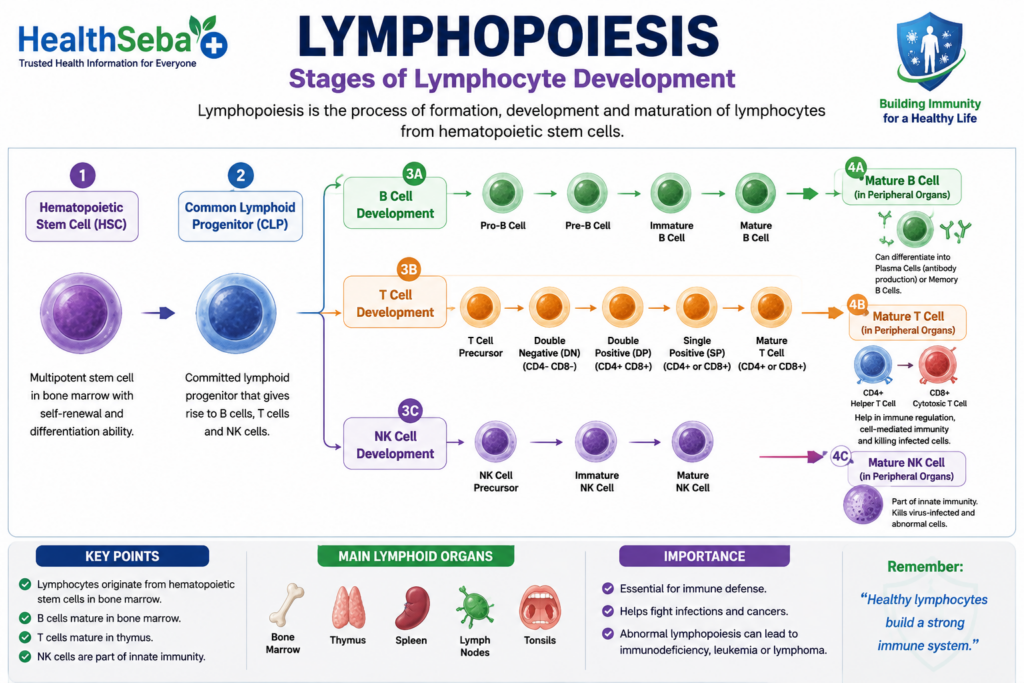
Lymphopoiesis is the process by which lymphocytes are formed and mature from hematopoietic stem cells. It involves several stages of differentiation that ultimately produce B cells, T cells, and natural killer (NK) cells.
Lymphopoiesis Pathway
Hematopoietic Stem Cell → Common Lymphoid Progenitor → B Cell / T Cell / NK Cell → Mature Lymphocyte
1. Hematopoietic Stem Cell
Lymphopoiesis begins with hematopoietic stem cells (HSCs), mainly located in the bone marrow.
HSCs have two important properties:
- Self-renewal – ability to produce new stem cells.
- Differentiation – ability to develop into specialized blood cells.
Some HSCs become committed to the lymphoid lineage, initiating lymphocyte development.
2. Common Lymphoid Progenitor
The Common Lymphoid Progenitor (CLP) is an important intermediate stage of lymphopoiesis.
CLPs give rise to major lymphoid cell lineages, including:
- B lymphocytes
- T lymphocytes
- Natural Killer (NK) cells
Further development is controlled by specific cellular signals, cytokines, and transcription factors.
3. B-Cell Development
B-cell development occurs mainly in the bone marrow.
The simplified sequence is:
Pro-B Cell → Pre-B Cell → Immature B Cell → Mature B Cell
During maturation, B cells develop a functional B-cell receptor (BCR) through genetic rearrangement.
Immature B cells undergo selection to help eliminate or control strongly self-reactive cells.
After maturation, activated B cells can differentiate into:
- Plasma cells – produce antibodies.
- Memory B cells – provide long-term immune memory.
4. T-Cell Development
T-cell precursors migrate from the bone marrow to the thymus, where they undergo maturation and selection.
The simplified pathway is:
T-Cell Precursor → Double-Negative → Double-Positive → Single-Positive → Mature T Cell
Double-Negative Stage
Early thymocytes do not express CD4 or CD8.
Double-Positive Stage
Developing thymocytes express both:
CD4⁺ CD8⁺
This stage is important for T-cell receptor development and selection.
Single-Positive Stage
After selection, mature T cells generally become:
- CD4⁺ T cells – mainly coordinate and regulate immune responses.
- CD8⁺ T cells – can destroy certain infected or abnormal cells.
5. NK-Cell Development
Natural Killer (NK) cells develop from lymphoid progenitors.
During maturation, NK cells acquire specialized receptors and cytotoxic functions.
Mature NK cells are important components of innate immunity and can recognize and destroy certain virus-infected or abnormal cells.
Their cytotoxic activity involves mechanisms associated with perforin and granzymes.
Summary
The major stages of lymphopoiesis can be summarized as:
Hematopoietic Stem Cell
↓
Common Lymphoid Progenitor
↓
B-Cell Lineage → Mature B Cell
T-Cell Lineage → Mature T Cell
NK-Cell Lineage → Mature NK Cell
Regulation of Lymphopoiesis
Lymphopoiesis is controlled by a complex interaction of cellular and molecular signals.
Important factors include:
- Cytokines
- Interleukins
- Growth factors
- Transcription factors
- Bone-marrow stromal cells
- Thymic microenvironment
- Antigen-receptor signaling
These signals regulate the survival, proliferation, differentiation and selection of developing lymphocytes.
Functions of Mature Lymphocytes
| Cell | Main Function |
|---|
| B cell | Antibody-mediated immunity |
| Plasma cell | Antibody production |
| Memory B cell | Long-term immune memory |
| Helper T cell | Coordinates immune responses |
| Cytotoxic T cell | Kills certain infected or abnormal cells |
| Regulatory T cell | Helps control immune responses |
| NK cell | Innate cytotoxic defense |
Clinical Importance of Lymphopoiesis
Abnormal lymphocyte production or maturation can result in several medical conditions.
Leukemia
Abnormal proliferation of lymphoid cells can occur in lymphoid leukemias.
Examples include:
- Acute lymphoblastic leukemia (ALL)
- Chronic lymphocytic leukemia (CLL)
Lymphoma
Lymphoma involves malignant transformation of lymphoid cells and commonly affects lymph nodes or other lymphoid tissues.
Immunodeficiency
Defects in lymphocyte development can result in impaired immune function and increased susceptibility to infections.
Lymphocytosis
An increased lymphocyte count is called lymphocytosis. It may occur in some infections and hematological disorders.
Lymphopenia
A reduced lymphocyte count is called lymphopenia or lymphocytopenia. It can occur in various infections, immune disorders, medications and systemic illnesses.
A lymphocyte abnormality should always be interpreted along with the patient’s clinical history and other laboratory findings.
Laboratory Tests Related to Lymphocytes
Several laboratory investigations can help evaluate lymphocytes.
Complete Blood Count (CBC)
CBC with differential provides information about total white blood cells and lymphocyte numbers.
Peripheral Blood Smear
A peripheral smear allows assessment of the morphology of circulating lymphocytes.
Flow Cytometry
Flow cytometry identifies different lymphocyte populations using surface markers.
Common markers include:
- CD3
- CD4
- CD8
- CD19
- CD20
- CD16
- CD56
Immunophenotyping
Immunophenotyping is particularly useful when evaluating suspected leukemia, lymphoma or other abnormal lymphoid populations.
Lymphopoiesis vs Erythropoiesis vs Myelopoiesis
Lymphopoiesis, erythropoiesis, and myelopoiesis are three important processes of hematopoiesis (blood cell formation). The main difference is the type of blood cells produced and their primary functions.
| Feature | Lymphopoiesis | Erythropoiesis | Myelopoiesis |
|---|
| Main product | Lymphocytes | Red blood cells (RBCs) | Myeloid cells |
| Major cells | B cells, T cells, NK cells | Erythrocytes | Neutrophils, eosinophils, basophils, monocytes and megakaryocyte lineage |
| Main function | Immune defense | Oxygen transport | Innate immunity, inflammation and hemostasis |
| Major site | Bone marrow; T-cell maturation in thymus | Bone marrow | Bone marrow |
| Lineage | Lymphoid | Erythroid | Myeloid |
| Important regulator | Cytokines and lineage-specific signals | Erythropoietin (EPO) | Cytokines and colony-stimulating factors |
| Examples of disorders | Lymphoma, lymphoid leukemia, immunodeficiency | Anemia, polycythemia | Myeloid leukemia, neutropenia, myeloproliferative disorders |
Conclusion
Lymphopoiesis is the complex process of lymphocyte formation, development and maturation from hematopoietic stem cells.B cells develop mainly in the bone marrow, while T-cell precursors migrate to the thymus for further maturation and selection. NK cells also arise from lymphoid progenitors and contribute to innate immune defense.The mature lymphocytes produced through this process are essential for antibody production, cellular immunity, immune regulation and protection against infections and abnormal cells.
A proper understanding of lymphopoiesis is therefore important for hematology, immunology, medical laboratory science and clinical medicine.
Disclaimer
This article is provided for educational and general health-information purposes only. It should not be considered a substitute for professional medical advice, diagnosis or treatment. Laboratory results must be interpreted in the appropriate clinical context. Consult a qualified healthcare professional for individual medical concerns.
Frequently Asked Questions
Written by Jambir Sk Certified Medical Laboratory Technologist
Disclaimer: This content is for educational purposes only and should not be consideredas medical advice. Always consult a qualified doctor.We do not provide professional medical advice, diagnosis, or treatment.All health-related content is based on research, knowledge, and general awareness.Always consult a licensed healthcare provider for any medical concerns.HealthSeba.com will not be responsible for any loss, harm, or damage caused by the use of information available on this site.
References & Sources
1. Book Reference
Book:Practical Pathology—P.CHAKRABORTY
Chapter: Chapter 13 – Blood Formation
Topic: Lymphoid Series / Maturation of Lymphocytes
Page: 72-75
Source: Practical Pathology textbook
2. Medical & Educational Sources
- Merck Manual Professional Edition — Information related to hematopoiesis, lymphocytes and blood disorders.
Merck Manual Professional Edition - Cleveland Clinic — Educational information related to lymphocytes and the immune system.
Cleveland Clinic - National Cancer Institute (NCI) — Information related to lymphocytes, blood cells, leukemia and lymphoma.
National Cancer Institute - PubMed / National Library of Medicine — Peer-reviewed medical literature related to lymphocyte development and hematopoiesis.
PubMed